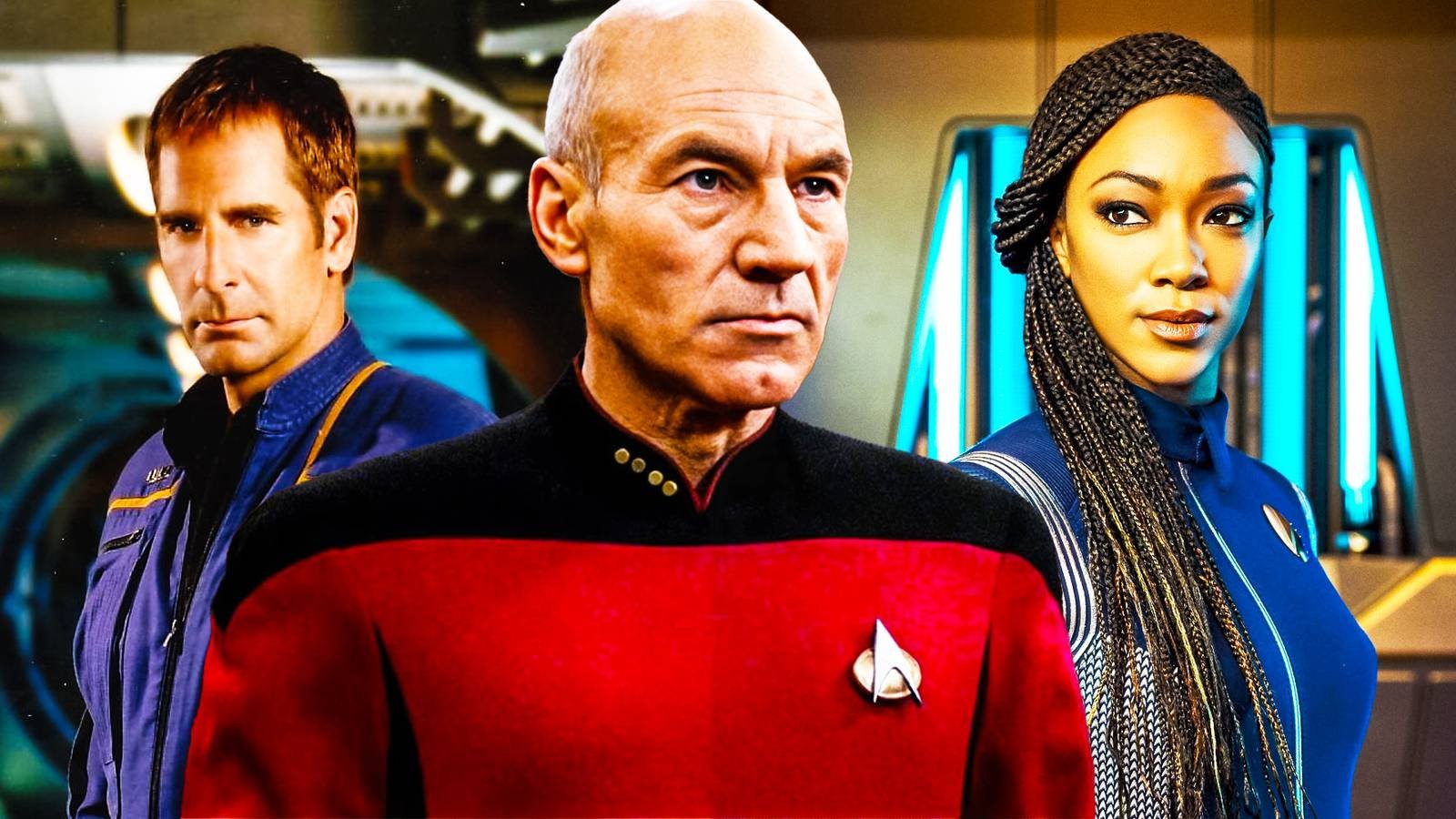
For over six decades, Gene Roddenberry's visionary universe, Star Trek, has captured the imaginations of millions, boldly going where no franchise has gone before. What began in 1966 as 'Star Trek: The Original Series,' a program initially struggling for ratings and lasting only three seasons on NBC, has since blossomed into a monumental cultural phenomenon. This sprawling saga now encompasses a dozen television series, numerous feature films, comics, novels, and video games, creating a rich tapestry of interstellar exploration, ethical dilemmas, and hopeful futures.
Navigating this vast universe can be an exhilarating yet daunting task for both newcomers and seasoned fans alike. While many viewers opt for release order, embarking on a chronological journey through Star Trek's television series offers a unique and profoundly rewarding experience. It allows for a deeper appreciation of the narrative evolution, technological advancements, and philosophical underpinnings that define the Federation and its allies, enemies, and uncharted territories.
The Appeal of Chronological Immersion
Watching Star Trek in its in-universe timeline order is akin to reading a multi-volume epic from cover to cover. This method provides unparalleled narrative cohesion, allowing viewers to witness the gradual development of the Federation from its nascent stages to its zenith, and even beyond. Character arcs, often spanning multiple series through familial connections or historical references, become more impactful. The evolution of starship technology, alien species, and political landscapes unfolds organically, enriching the understanding of the entire canon.
Furthermore, a chronological approach helps to contextualize events and avoid potential spoilers. Later series frequently reference pivotal moments, characters, or technological breakthroughs introduced in earlier, chronologically preceding shows. By following the timeline, viewers experience these revelations as intended, fostering a more immersive and surprising journey through the final frontier. It transforms a collection of disparate shows into a unified, unfolding grand narrative.
A Brief Chronological Overview of the Star Trek Universe
The Star Trek universe primarily operates within a single 'Prime Timeline,' with occasional deviations or alternate realities, most notably the 'Kelvin Timeline' films. However, for television series, the focus remains firmly on the Prime Timeline. This continuity began with humanity's first steps into deep space exploration, eventually leading to the formation of the United Federation of Planets, a vast interstellar government dedicated to exploration, scientific discovery, and peaceful coexistence. The timeline stretches from the mid-22nd century, through the iconic five-year mission of Captain Kirk, into the more diplomatic era of Captain Picard, and further into the future with new challenges and discoveries.
Understanding the broad historical periods within Star Trek is key. The initial era covers the birth of warp drive and the challenging pre-Federation years. Next comes the classic era of exploration and diplomacy, followed by a period of expanding Federation influence and escalating galactic conflicts. Finally, the modern series explore both the immediate aftermath of historical events and distant futures, continually redefining what it means to be part of Starfleet and the Federation.
The Definitive Star Trek TV Series Chronological Viewing Order
Below is the recommended chronological viewing order for all live-action and animated Star Trek television series. This sequence is based on the in-universe events as they unfold, rather than their original release dates. Note that some series, like 'Star Trek: Discovery,' feature significant time jumps that are accounted for in their respective descriptions.
1. Star Trek: Enterprise (2151 – 2161)
The true beginning of the televised Star Trek saga, 'Enterprise' predates the Federation by a decade, following Captain Jonathan Archer and the crew of Earth's first warp-five starship, the NX-01 Enterprise. This prequel series depicts humanity's earliest deep space missions, their first encounters with iconic alien species like the Vulcans, Andorians, and Klingons, and the harrowing Xindi War that almost destroyed Earth. It lays the groundwork for the formation of the United Federation of Planets, showcasing the challenges and triumphs of early interstellar diplomacy and conflict.
2. Star Trek: Discovery (Seasons 1-2: 2255 – 2258)
Set a decade before Captain Kirk's five-year mission, the initial seasons of 'Discovery' introduce Michael Burnham, a human raised on Vulcan, who finds herself aboard the USS Discovery during a brutal war with the Klingon Empire. The series explores advanced spore drive technology, Section 31's clandestine operations, and features a young Captain Pike and Spock. These seasons are crucial for understanding the immediate pre-Original Series era, presenting a darker, more complex Starfleet during a period of intense galactic tension.
3. Star Trek: Strange New Worlds (2259 – Present)
Directly following the events of 'Discovery' Season 2, 'Strange New Worlds' revives the episodic exploration format, focusing on Captain Christopher Pike, Number One (Una Chin-Riley), and a younger Spock aboard the USS Enterprise (NCC-1701). This series captures the spirit of the original show's optimism and sense of wonder, exploring new civilizations, scientific anomalies, and ethical quandaries, all while balancing continuity with fresh storytelling. It bridges the gap between 'Enterprise' and 'The Original Series' seamlessly.
4. Star Trek: The Original Series (2265 – 2269)
The series that started it all, 'The Original Series' follows Captain James T. Kirk, Mr. Spock, and Dr. Leonard 'Bones' McCoy aboard the USS Enterprise (NCC-1701) on their historic five-year mission of deep space exploration. This era defined Star Trek's core tenets: exploring strange new worlds, seeking out new life and new civilizations, and boldly going. It grappled with Cold War anxieties, civil rights, and the potential of humanity, setting the benchmark for science fiction storytelling.
5. Star Trek: The Animated Series (2269 – 2270)
An animated continuation of 'The Original Series,' featuring most of the original cast reprising their voice roles. Though often overlooked, 'The Animated Series' expands on the five-year mission, introducing new alien races and concepts that later became part of official Star Trek canon. It offers lighter, imaginative stories and further solidifies the adventures of Kirk's crew.
6. Star Trek: The Next Generation (2364 – 2370)
Set approximately a century after Kirk's adventures, 'The Next Generation' introduces Captain Jean-Luc Picard and the crew of the new USS Enterprise (NCC-1701-D). This series redefined Star Trek for a new era, focusing more on diplomacy, philosophical debates, and the complexities of a highly evolved Federation. It introduced iconic characters like Data, Worf, and Troi, and explored advanced alien threats such as the Borg and Q.
7. Star Trek: Deep Space Nine (2369 – 2375)
Running concurrently with the latter half of 'The Next Generation' and 'Voyager,' 'Deep Space Nine' broke new ground by being set on a stationary space station orbiting the planet Bajor. Commander (later Captain) Benjamin Sisko and his crew navigate political intrigue, religious prophecy, and the devastating Dominion War. This series is known for its serialized storytelling, darker themes, and profound exploration of faith, war, and cultural identity.
8. Star Trek: Voyager (2371 – 2378)
Also overlapping with 'The Next Generation' and 'Deep Space Nine,' 'Voyager' sees Captain Kathryn Janeway and her crew stranded 70,000 light-years from home in the uncharted Delta Quadrant. Their perilous seven-year journey back to Earth forces them to forge alliances with former enemies, innovate with limited resources, and confront new alien species, including the formidable Borg. The series focuses on themes of resourcefulness, morality in extreme circumstances, and the meaning of home.
9. Star Trek: Lower Decks (2380 – Present)
This animated comedy series, set shortly after the events of 'Star Trek: Nemesis,' offers a humorous look at the day-to-day lives of the 'lower deckers,' or supporting crew, on the relatively unimportant USS Cerritos. While comedic, 'Lower Decks' is deeply respectful of Star Trek lore, providing countless Easter eggs and genuine character development. It expands on the post-'Next Generation' era, showing a more bureaucratic and sometimes absurd side of Starfleet.
10. Star Trek: Prodigy (2383 – Present)
Aimed at a younger audience, 'Prodigy' is an animated series set after 'Lower Decks' and before 'Picard.' It follows a group of young alien outcasts who discover an abandoned Starfleet ship, the USS Protostar, and, with the help of a holographic Janeway, learn about Starfleet ideals as they try to reach Federation space. This series introduces the Star Trek universe to a new generation, exploring themes of belonging, leadership, and the universal appeal of Starfleet's mission.
11. Star Trek: Picard (2399 – 2401)
Taking place two decades after 'Star Trek: Nemesis,' 'Picard' revisits the beloved former captain of the Enterprise, Jean-Luc Picard, now retired and grappling with the Federation's changing values and his own past. The series explores themes of legacy, redemption, and the evolving nature of artificial intelligence, bringing back many iconic characters from 'The Next Generation' and 'Voyager' for new adventures in a more complex and sometimes morally ambiguous future.
12. Star Trek: Discovery (Seasons 3-5: 3188 – Present)
Following their pivotal jump through a wormhole at the end of Season 2, the crew of the USS Discovery finds themselves nearly a millennium in the future, in the 32nd century. This era depicts a Federation severely weakened by 'The Burn,' a catastrophic event that crippled warp travel. These later seasons explore rebuilding efforts, the nature of the galaxy without a dominant Federation, and the challenges of adapting to a drastically changed future, providing the furthest chronological glimpse into the Prime Timeline.
The Journey Ahead
Embarking on this chronological journey through Star Trek is more than just watching television; it's an educational and emotionally resonant experience. It offers a unique perspective on the evolution of a hopeful future, the triumphs and failures of a galactic civilization, and the enduring human spirit of exploration and discovery. From the pioneering days of 'Enterprise' to the far-flung future of 'Discovery' Season 3 and beyond, each series contributes a vital piece to a magnificent mosaic.
This carefully curated viewing order promises a coherent, enriching, and deeply satisfying voyage through the ever-expanding Star Trek universe. Whether you are a dedicated Trekkie or a curious newcomer, preparing for this journey means preparing to be captivated, challenged, and inspired by the enduring vision of Gene Roddenberry. For more comprehensive guides, in-depth analyses, and the latest news from every corner of the Star Trek universe, continue exploring NAME OF SITE's extensive archives and daily updates.
Fonte: https://screenrant.com