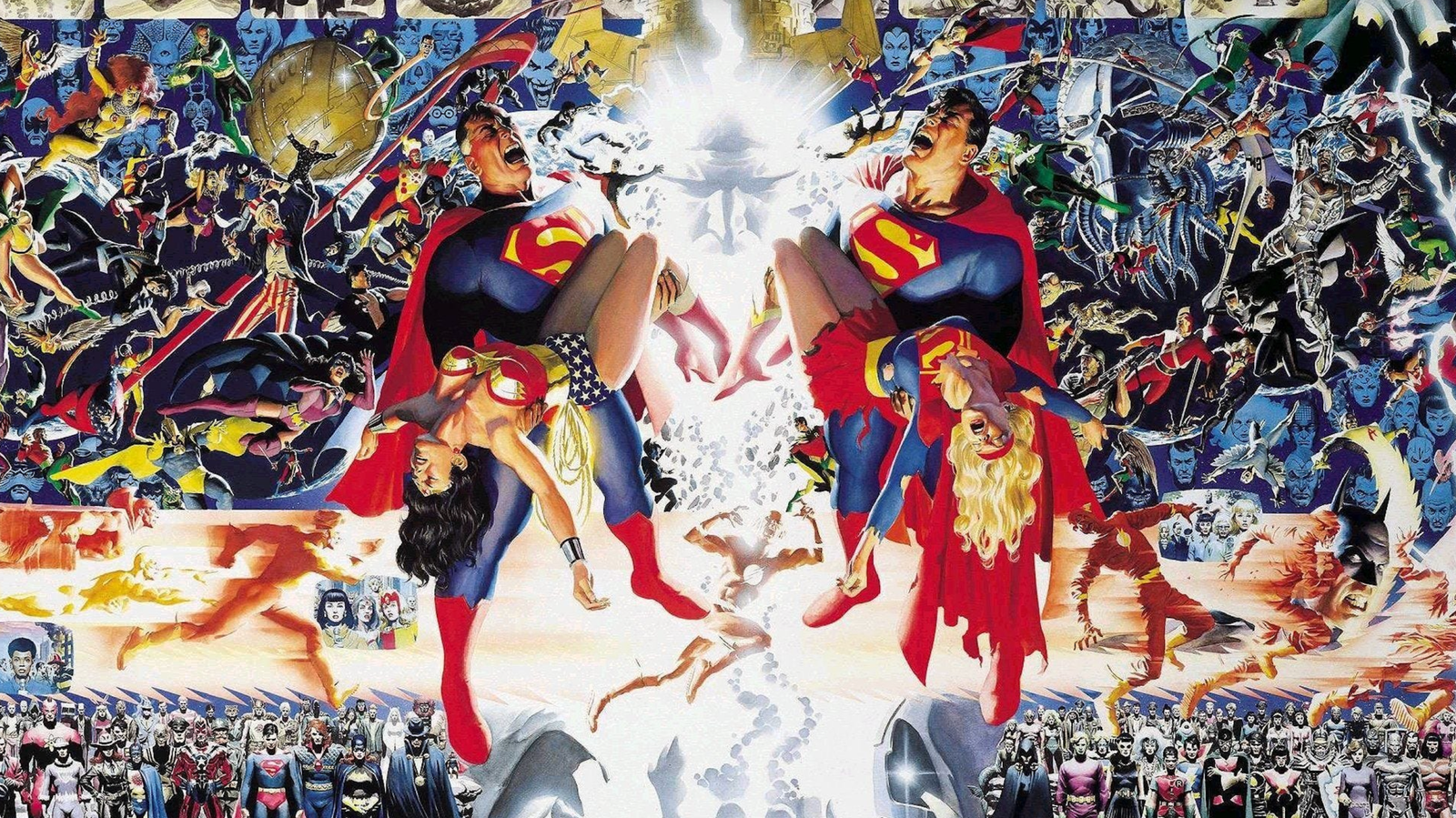
In 1985, the landscape of comic books was irrevocably altered with the debut of DC Comics' seminal storyline, <i>Crisis on Infinite Earths</i>. This twelve-issue saga, a collaborative masterpiece by writer Marv Wolfman and artist George Pérez, embarked on an ambitious mission to redefine not just DC's continuity, but the very fabric of its existence. At its core, the narrative introduced an existential threat in the form of the Anti-Monitor, a cosmic entity of immense power hell-bent on eradicating the multiverse. As countless worlds crumbled under his onslaught, heroes and villains from disparate realities were forced into an unprecedented alliance, fighting a desperate battle for all of creation. This monumental event fundamentally reshaped the comic book industry, establishing a new paradigm for large-scale crossovers, featuring character deaths with profound and enduring consequences, and orchestrating a comprehensive reboot of the entire DC Universe. The moments within this storyline are not merely plot points; they are touchstones that cemented its status as a legend.
A Multiverse in Peril: The Genesis of Crisis
The early 1980s found DC Comics grappling with a complex and increasingly unwieldy continuity. Over decades, the accumulation of countless alternate Earths – born from editorial decisions, retcons, and the acquisition of characters from defunct publishers like Quality, Charlton, and Fawcett Comics – had created a confusing labyrinth for both long-time readers and potential newcomers. Differentiating between Golden Age, Silver Age, and various other iterations of universes and characters became a formidable challenge. This intricate, often contradictory, web of storylines threatened to alienate audiences and stifle creative storytelling. Recognizing the urgent need for a clean slate, DC Comics conceived <i>Crisis on Infinite Earths</i> not only as a means to reboot its universe but also to consolidate its vast intellectual properties into a cohesive, singular continuity. It was a high-stakes gamble, yet its resounding success transformed it into one of the greatest triumphs in comic book history, proving that a bold narrative could streamline a fractured universe while honoring its rich legacy.
Unforgettable Chapters: The Pivotal Moments of Crisis on Infinite Earths
7. The Grim Annihilation of Earth-3
To immediately establish the cosmic stakes, the inaugural universe depicted falling victim to the Anti-Monitor's relentless antimatter wave was Earth-3. This reality was famously home to the Crime Syndicate, the malevolent doppelgängers of the Justice League. Despite their villainous nature, these characters faced their demise with an uncharacteristic, almost heroic, resistance against an unstoppable force. The scene is not only chilling in its depiction of total annihilation but also offers a rare glimpse into the Crime Syndicate's potential for self-preservation and desperate courage, mirroring their mainline counterparts' fight for justice. Furthermore, this moment contains a poignant allusion to Superman's own origin, as Earth-3's benevolent Alexander Luthor manages to launch his infant son into space, shielding him from his world's destruction, echoing the tale of Kal-El escaping Krypton. This grim opening firmly established the Anti-Monitor as a threat of unparalleled magnitude, capable of erasing entire realities with terrifying ease.
6. The Grand Assembly of Multiversal Heroes
As the Anti-Monitor unleashed his genocidal rampage across the multiverse, his benevolent counterpart, the Monitor, orchestrated the most ambitious superhero gathering ever conceived. Drawing heroes and even some villains from the dwindling number of surviving universes, the Monitor brought together an eclectic roster encompassing characters from the Golden Age, Silver Age, and the acquired universes of Charlton, Quality, and Fawcett Comics. This unprecedented convergence was a love letter to DC's expansive publishing history, celebrating every corner of its diverse catalog. When temporal fluctuations began to manifest, bringing dinosaurs and cowboys into the modern era, the Monitor's apprentice, Harbinger, expanded the assembly further. Virtually every hero from DC's storied past was present, from the World War II-era Blackhawks to the Legion of Super-Heroes from the far future. Witnessing the Supermen of both the Golden and Silver Ages interact for the first time was a powerful, symbolic moment, underscoring the collective strength required to face a threat of multiversal proportions and highlighting the rich tapestry of characters DC had cultivated over decades.
5. The Definitive Fall of the Anti-Monitor
Throughout <i>Crisis</i>, the Anti-Monitor proved to be an adversary of unparalleled resilience, seemingly perishing only to return with renewed vigor and claiming more beloved lives. His ability to effortlessly erase entire universes made his defeat an arduous, near-impossible task. Even at the brink of destruction, the Anti-Monitor remained a formidable threat, attempting one last suicide attack against his foes. It took the combined, desperate might of an unlikely alliance — two versions of Superman, the powerful Superboy-Prime, the brilliant Alexander Luthor Jr., and even the tyrannical Darkseid — to finally confront this cosmic menace. Overwhelmed by the sheer scale of the Anti-Monitor's atrocities, the Golden Age Superman roared his defiance, delivering a universe-shaking punch that ultimately shattered the villain's physical form. This cathartic moment, born from collective suffering and a desperate desire for an end to the destruction, signified a pivotal turning point, finally bringing down the seemingly invincible architect of multiversal collapse.
4. The Cosmic Confrontation at the Dawn of Creation
In DC Comics lore, the original multiverse was born from the hubris of the alien scientist Krona, who peered into a forbidden machine to witness the universe's genesis. His forbidden glance triggered an explosion, giving birth to the myriad realities. Seizing an opportunity to reshape all existence to his will, the Anti-Monitor traveled back to this pivotal moment, intending to usurp Krona's role and become the very hand that shaped the cosmos, ensuring a reality where he alone reigned supreme. Heroes and villains alike converged at the dawn of time, engaging in an epic battle of cosmic proportions. Just as the Anti-Monitor seemed on the verge of victory, the Spectre intervened, engaging the Anti-Monitor in a metaphysical struggle that transcended physical combat. When Krona, in his forbidden observation, witnessed not one but two hands at creation's genesis — the Anti-Monitor's and the Spectre's — the resulting paradox was catastrophic. This moment didn't merely prevent the Anti-Monitor's victory; it caused the existing multiverse to collapse, paving the way for the birth of a singular, new universe from the ashes of the old, fundamentally altering the fabric of reality.
3. The Ultimate Sacrifice: The Death of Barry Allen, The Flash
Among the most poignant and impactful moments of <i>Crisis on Infinite Earths</i> was the heroic demise of Barry Allen, the Silver Age Flash. When the Anti-Monitor threatened to obliterate the remaining universes with an antimatter cannon, Barry Allen understood the dire necessity of intervention. In a selfless act of unparalleled heroism, he channeled his Speed Force to generate a counter-energy surge, running faster than he ever had before. This incredible feat of speed and willpower not only destroyed the Anti-Monitor's weapon but also saved billions of lives across multiple Earths. The effort, however, proved too much for him. As he sped across reality, Barry Allen disintegrated into pure energy, absorbed into the very Speed Force he wielded. His death was a stark and brutal reminder of the event's unforgiving nature, leaving an indelible mark on the DC Universe. It was a defining sacrifice that solidified the stakes of the Crisis, proving that no hero, regardless of their legacy or power, was safe from the Anti-Monitor's wrath, and setting a precedent for profound character transformations and selflessness in the face of ultimate evil.
2. A Hero's Farewell: Supergirl's Valiant Demise
Another devastating loss that underscored the gravitas of <i>Crisis</i> was the death of Supergirl, Kara Zor-El. In a critical juncture of the battle, as the Anti-Monitor was about to deliver a fatal blow to her cousin, Superman, and imperil the last surviving Earths, Supergirl intervened without hesitation. Despite being outmatched by the Anti-Monitor's immense power, she threw herself into a desperate, one-sided struggle to protect her family and all existence. She managed to critically wound the Anti-Monitor, temporarily crippling him and buying precious time for the other heroes, but at an unbearable cost. Mortally wounded by the villain's retaliatory attack, Kara Zor-El succumbed to her injuries, dying in Superman's arms. Her sacrifice was deeply emotional, emphasizing the personal toll of the war and making a powerful statement that even the most iconic and seemingly invulnerable characters could fall. Supergirl's death resonated deeply with readers and characters alike, serving as a powerful symbol of the extreme sacrifices required to save reality and solidifying <i>Crisis on Infinite Earths</i> as an event where consequences were both real and irreversible.
1. The Birth of a New Earth: A Unified Universe Emerges
The ultimate and most profound moment of <i>Crisis on Infinite Earths</i> was the climactic forging of a single, unified Earth. As the dust settled from the multiversal cataclysm, the few remaining parallel Earths — Earth-1, Earth-2, Earth-4, Earth-S, and Earth-X — were collapsed into one composite reality. This unprecedented event marked the culmination of the entire saga's purpose: to streamline DC's convoluted continuity into a cohesive, accessible universe. Heroes from different realities found themselves coexisting, their individual histories subtly (or sometimes dramatically) reshaped to fit the new singular timeline. While a select few, like Superman and Batman, retained a fragmented memory of the multiverse, the vast majority of the population and even many heroes had no recollection of the countless Earths that once were. This new Earth was a blank slate, offering fresh narrative opportunities and an organized foundation for future storytelling. The birth of this unified universe cemented <i>Crisis on Infinite Earths</i> as arguably the most impactful and consequential event in comic book history, a monumental achievement that redefined an entire fictional world and influenced decades of subsequent narratives.
The Enduring Legacy of Crisis on Infinite Earths
<i>Crisis on Infinite Earths</i> transcends its status as a mere comic book story; it is a cultural touchstone that reshaped the narrative possibilities of the superhero genre. Its innovative approach to large-scale crossovers, where every battle and every death carried genuine weight, set the gold standard for subsequent 'event' comics across the industry. The permanent changes inflicted upon DC's continuity — from the deaths of major characters like Supergirl and Flash to the complete restructuring of its universe — proved that comic book narratives could have profound, long-lasting consequences, a rarity at the time. The event provided a vital reset, making the DC Universe more coherent and approachable for new readers, while still honoring the rich history that preceded it. Its influence continues to be felt in modern storytelling, with its themes of sacrifice, unity, and cosmic upheaval serving as a blueprint for countless subsequent narratives. Decades later, <i>Crisis on Infinite Earths</i> remains a powerful testament to the creative vision of Marv Wolfman and George Pérez, solidifying its place as an unparalleled masterpiece and a perpetual benchmark in the pantheon of comic book literature.
The depth and impact of <i>Crisis on Infinite Earths</i> continue to fascinate fans and scholars alike. Dive deeper into the lore, character analyses, and historical significance of this and other seminal comic book events by exploring more in-depth articles and features available right here on NAME OF SITE. Uncover new perspectives and expand your understanding of the worlds that captivate us.
Fonte: https://comicbook.com