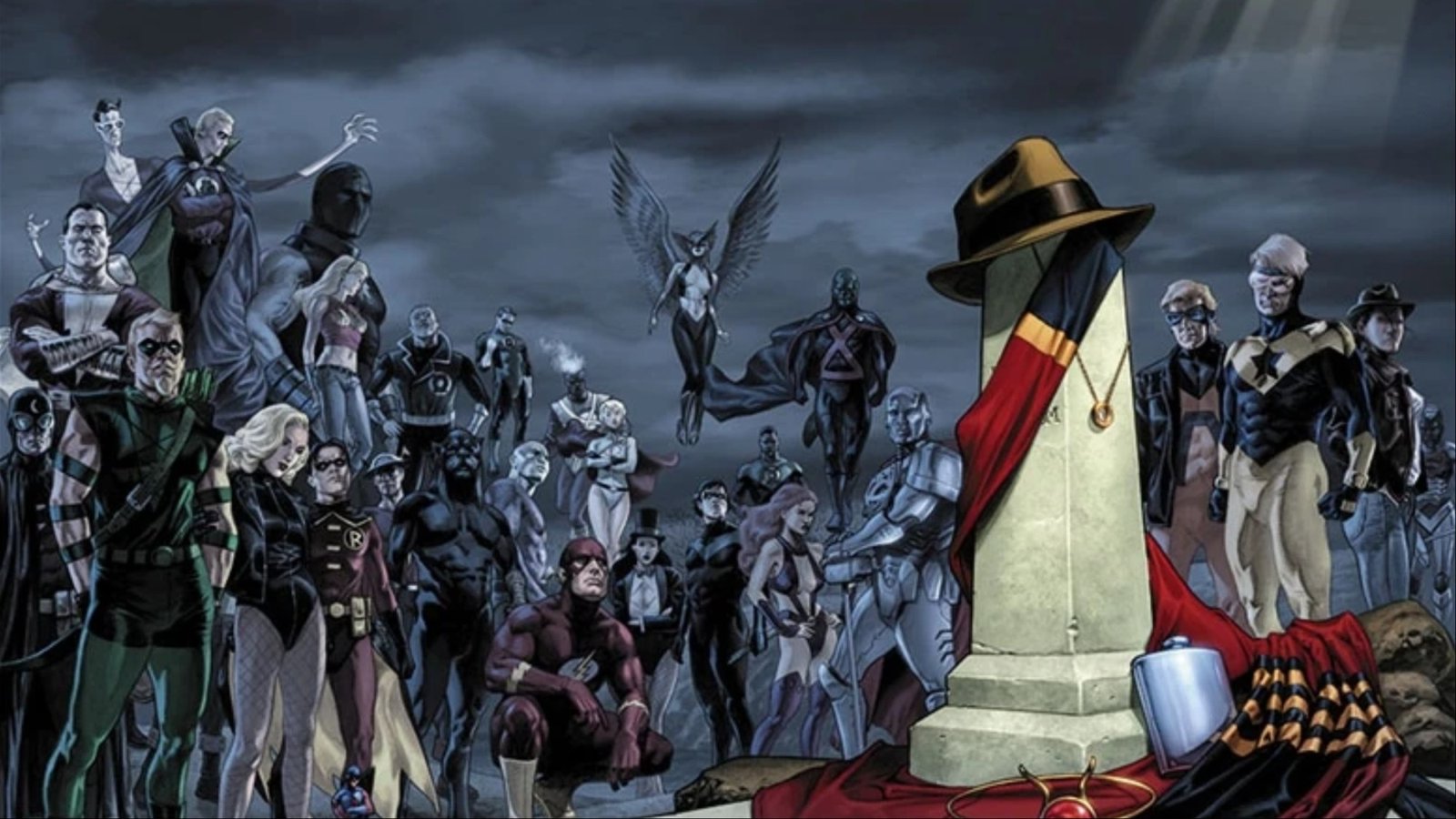
The early 2000s represented a vibrant and creatively charged era for DC Comics. Following the turbulent narrative shifts of the 1990s, which the publisher navigated with remarkable resilience compared to its competition, DC had assembled a formidable roster of brilliant writers and artists. A pivotal moment arrived in 2005, marking the twentieth anniversary of the groundbreaking *Crisis on Infinite Earths*. This milestone was celebrated and re-evaluated through the blockbuster event *Infinite Crisis*, which notably undid some of the established changes in the post-*Crisis* DC Universe. In the wake of *Infinite Crisis*, the entire DC line famously jumped forward by one year, leaving a significant chronological gap that demanded exploration. This narrative vacuum was expertly filled by *52*, a groundbreaking weekly series that chronicled the events of that missing year, redefining the landscape of the DCU and elevating several characters to their definitive forms.
Launched in tandem with Marvel's popular *Civil War* event, *52* stood out as a masterclass in serialized storytelling. Spearheaded by an acclaimed writing team—Geoff Johns, Mark Waid, Greg Rucka, and Grant Morrison—with Keith Giffen providing essential art breakdowns for a rotating team of artists, the series diverged from focusing solely on the DC Trinity (Superman, Batman, Wonder Woman). Instead, it brilliantly shined a spotlight on a diverse cast of B and C-list heroes, allowing readers to experience the new post-*Infinite Crisis* world through the eyes of often-underutilized characters. This innovative approach, coupled with its consistent quality, made *52* the most talked-about comic on the internet during its run, proving that a weekly format could not only be sustainable but profoundly impactful. For many, *52* wasn't just a great story; it was *the* great story that brought out the absolute best in some of DC's most beloved and underrated characters, arcs that, for some, have never quite been matched since.
Characters Forged Anew: Their Defining Moments in 52
Steel: The Architect of Self-Redemption
John Henry Irons, known as Steel, emerged in the aftermath of the seminal 'Death of Superman' storyline in the 1990s. Initially positioned as one of Superman's potential successors, Steel carved out his own niche, earning a spot in the Justice League and becoming an ancillary member of the Superman Family. Despite his impressive intellect and engineering prowess, by the time *52* began, Steel had largely faded from the spotlight, often relegated to background appearances in major crossover events. His personal struggles, particularly concerning his niece Natasha, further complicated his already diminished public profile, leaving him somewhat disillusioned with the hero's life.
In *52*, Steel found himself drawn into the orbit of Lex Luthor's insidious 'Everyman Project,' a controversial initiative designed to grant ordinary people metahuman abilities. Luthor, leveraging his public persona as a benevolent innovator, sought to create a new generation of metahumans under his control. Steel's involvement was initially driven by a desire to protect his niece, Natasha, who had enrolled in the program. However, his inherent sense of justice and his scientific acumen soon led him to suspect Luthor's true intentions. He meticulously investigated the project, uncovering the sinister truth that Luthor was not only secretly experimenting on participants but also deliberately sabotaging their powers, rendering them dependent and vulnerable.
This revelation propelled Steel into a direct confrontation with Luthor, not as Superman's sidekick or ally, but as an independent force. He masterfully dismantled Luthor's scheme, exposing the villain's treachery to the world and liberating the Everyman participants from their technologically induced servitude. This decisive victory, achieved primarily through his own ingenuity, moral fortitude, and sheer will, represented Steel's greatest triumph. It was a moment where John Henry Irons truly stood on his own, using his mind and might to defeat one of the DC Universe's most formidable intellects. This arc cemented Steel's identity as a hero defined by integrity and innovation, an unparalleled highlight in his storied career that underscored his independent importance.
Rip Hunter: The Unsung Guardian of Time
Rip Hunter, a time-traveling adventurer from the Silver Age, was a character often relegated to the fringes of DC continuity, known more for his quirky sci-fi escapades than for playing a pivotal role in major events. Before *52*, he was a relatively obscure figure, occasionally resurfacing to warn heroes about temporal anomalies but lacking a truly central, defining storyline that showcased his full potential as a master of time. His narrative presence was intermittent, leaving his character ripe for a meaningful reintroduction.
In *52*, Rip Hunter emerged from the shadows as a crucial, albeit elusive, figure. With time itself seemingly breaking down in the aftermath of *Infinite Crisis*—evidenced by inconsistencies, disappearing heroes, and paradoxical events—Booster Gold, driven by a rare moment of genuine concern, sought out Hunter. Rip, however, had vanished, leaving behind a cryptic blackboard covered in an ever-changing labyrinth of clues, equations, and warnings. These intricate messages became the central mystery, guiding Booster Gold on a desperate search through the timestream to find the missing chrononaut and unravel the profound instability affecting the universe.
Upon finally being found, Rip Hunter revealed the true gravity of the situation: the multiverse was actively dying, being consumed by a malevolent force. His partnership with Booster Gold, initially an odd couple dynamic, became the engine of the series' overarching mystery. Rip’s deep understanding of temporal mechanics and his relentless pursuit of truth were instrumental in piecing together the fragmented reality. He orchestrated the heroes' efforts to repair the damaged timeline and ultimately played a vital role in the final confrontation against the true mastermind of the universal instability. *52* not only brought Rip Hunter back into relevance but established him as an indispensable protector of time, a brilliant, if eccentric, strategist whose contributions were essential to the very fabric of existence.
Mr. Mind: The Cosmic Threat Unveiled
Mr. Mind, a diminutive Venusian worm, has long been one of Captain Marvel's (Shazam's) most eccentric villains. Originating in the Golden Age, his initial appearances were often characterized by a whimsical, almost comical menace, leading the 'Monster Society of Evil' with an absurd, albeit dangerous, cunning. Despite his high intelligence and telepathic abilities, his unassuming appearance and outlandish schemes often prevented him from being taken as seriously as other top-tier DC villains. He was a character whose potential for true cosmic horror remained largely untapped, often perceived as more of a novelty than a genuine existential threat.
*52* ingeniously re-contextualized Mr. Mind, transforming him from a humorous antagonist into the series' chilling, overarching secret villain. Exploiting the inherent instability of the universe following *Infinite Crisis*—the very 'holes' in reality that Rip Hunter detected—Mr. Mind embarked on a terrifying mission. He began literally feeding on the fragmented timelines and alternate realities of the burgeoning multiverse, growing in power and intent on recreating a twisted version of the multiverse solely for his own dominion. This subtle, insidious manipulation made him a far more terrifying force, operating from the shadows and orchestrating events with a horrifying patience.
As the series progressed, Mr. Mind's true form and capabilities were gradually revealed, culminating in the terrifying 'Hyperfly' stage—a monstrous, multi-dimensional insectoid creature of immense power. This grotesque evolution underscored the sheer scale of the threat he posed, not just to Earth, but to all of reality. *52* successfully transformed a villain who was once considered a mere joke into a truly cosmic-level entity, a living engine of destruction capable of consuming entire universes. This portrayal was the pinnacle of his villainous career, showcasing the character's capacity for terrifying ambition and establishing him as one of DC's most unexpectedly profound threats. He became a testament to the idea that even the most seemingly innocuous villain can harbor universe-shattering potential.
The Question (Vic Sage): A Final Search for Meaning
Vic Sage, the enigmatic vigilante known as the Question, has always been a character steeped in philosophy and existential inquiry. Originally conceived by Steve Ditko with an objectivist bent, his most acclaimed interpretation under Denny O'Neil in the late 1980s saw him as a spiritual seeker, a martial artist, and the humble defender of Hub City, constantly striving to uncover the truth behind every mystery. While his past stories were impactful, *52* provided Vic with his most profoundly human and poignant arc, allowing him to connect with a new generation of readers on a deeply personal level as he confronted his own mortality.
In *52*, Vic Sage was revealed to be battling terminal lung cancer, a secret he kept close even as he continued his relentless pursuit of justice. This diagnosis injected his quest with an urgent, introspective quality, shifting his focus from merely solving mysteries to finding meaning in his final days. He sought out Renee Montoya, a disgraced former Gotham City detective, not just for her investigative skills but, more subtly, as a potential successor. Vic guided Renee through a dangerous investigation into a mysterious criminal religion, simultaneously mentoring her in his unique brand of street-level philosophy and detective work, pushing her to look beyond the surface of reality and question everything.
Vic's arc in *52* was a moving exploration of legacy, mentorship, and finding peace in the face of inevitable death. He made an earnest effort to forge a genuine human connection with Renee, sharing his wisdom and imparting his unique worldview, all while confronting his own vulnerability. His journey took him from the grimy streets of Hub City to a profound spiritual experience in Nanda Parbat, where he ultimately found a measure of peace before his passing. This storyline provided a definitive, emotionally resonant conclusion to Vic Sage's tenure as the Question, leaving the world with a powerful testament to his enduring spirit and ensuring his legacy would continue through a worthy successor. It was a masterpiece of character development, cementing his place as one of DC's most compelling philosophical heroes.
Renee Montoya: From Despair to Destiny
Renee Montoya’s journey prior to *52* was already one of compelling drama and personal struggle. As a detective in the Gotham City Police Department, her character was a cornerstone of the critically acclaimed series *Gotham Central*, which depicted the grueling lives of ordinary police officers in a city dominated by superheroes and supervillains. Her storyline in *Gotham Central* explored her personal and professional challenges, including her struggles with her sexuality and the discrimination she faced. However, *52* found Renee at her absolute lowest ebb, having lost her job at the GCPD following the tragic death of her partner, Crispus Allen, and grappling with alcoholism and a profound sense of despair. She was a woman adrift, stripped of her identity and purpose.
It was in this state of profound vulnerability that Renee was sought out by Vic Sage, the Question. Their initial interactions were fraught with tension, as Renee resisted Vic's seemingly cryptic and often abrasive methods. However, through a series of intense investigations into the mysterious religion of Crime, Vic subtly began to train Renee, not just in detective skills but in a deeper, more philosophical approach to truth-seeking. This mentorship was transformative, pushing Renee to confront her inner demons and rediscover her own moral compass. During this period, readers were also introduced to Kate Kane, the new Batwoman, and learned about her past romantic relationship with Renee, adding another layer of personal complexity and emotional depth to Montoya’s arc.
Renee's journey culminated in her taking on the mantle of the Question after Vic Sage’s passing. This was not merely an inheritance but a powerful act of redemption and self-actualization. She utilized all her honed detective skills, martial arts training, and newfound philosophical insight to unravel the mysteries of *52*, ultimately saving the day alongside other heroes. Her transformation from a despondent, disgraced detective to a worthy successor of the Question was one of the most compelling character arcs in the series. It surpassed even her impressive run in *Gotham Central*, cementing her as a resilient, complex, and deeply human hero who found purpose and identity amidst chaos. Her story in *52* is a testament to the power of growth, mentorship, and the enduring human spirit.
Booster Gold: The Hero Who Earned His Stripes
Michael Jon Carter, known as Booster Gold, arrived in the present from the 25th century, armed with future tech and a burning desire for fame and fortune. For much of his career, Booster was often perceived as a comedic relief, a glory-seeking buffoon, or a B-list hero who was more interested in endorsements than heroics. While he occasionally showed flashes of genuine heroism, his self-serving motivations often overshadowed his true potential. Before *52*, he was largely an underestimated figure, a punchline in a universe filled with more serious, established icons, often struggling to gain the respect he secretly craved.
In the immediate aftermath of *Infinite Crisis*, Booster Gold was one of the few characters who recognized that something was fundamentally wrong with the timeline. The universe was full of inconsistencies, missing people, and strange temporal anomalies that only he, a time-traveler, seemed to truly notice. This realization spurred him on a desperate, self-sacrificing quest to find Rip Hunter, the only other person he believed could understand the gravity of the situation. His search was driven not by a desire for fame, but by a genuine, profound concern for reality itself. He became the reluctant, often ridiculed, yet indispensable point-of-view character for the larger temporal mystery of *52*, partnering with his robotic companion Skeets to follow Rip's cryptic clues.
Booster's arc in *52* was a remarkable journey of growth and redemption. He shed his superficiality, embracing the responsibilities of a true hero who understood the stakes. His partnership with Rip Hunter, characterized by Booster's sometimes comical exasperation but ultimate loyalty, was crucial to unraveling the secrets of the multiverse. By the series' conclusion, Booster Gold played a pivotal role in saving the multiverse, earning the respect of his peers and, more importantly, his own self-respect. *52* transformed Booster Gold from a cosmic joke into a genuine, albeit still flawed, protector of time, proving his immense worth and solidifying his place as a significant, multifaceted character in the DC Universe. This was his undisputed moment to shine, a definitive arc that proved he was capable of greatness.
Black Adam: The Wrath of Kahndaq
Teth-Adam, better known as Black Adam, has always been a complex figure in the DC Universe. Originally a villain, he was reimagined in the 2000s as an anti-hero, a powerful and morally ambiguous ruler of the fictional Middle Eastern nation of Kahndaq. Prior to *52*, he had achieved a measure of stability, attempting to establish a just, albeit authoritarian, regime and striving to build a family with Isis and her brother Osiris. This new status quo presented a fascinating moral dilemma: could a character with such a brutal past truly find peace and lead a nation with a sense of justice, even if it was a harsh one?
*52* plunged Black Adam into a deeply personal and utterly devastating tragedy. His attempts at creating a stable, loving family with Isis and Osiris were brutally shattered when Osiris and Isis were murdered by agents manipulated by Intergang and the enigmatic forces behind Mr. Mind’s schemes. This profound loss broke something fundamental within Black Adam. His grief quickly transformed into an unbridled, incandescent rage, consuming him entirely and erasing any semblance of the anti-hero he had tried to become. This catastrophic emotional unraveling set the stage for one of the most impactful storylines in DC history.
His descent culminated in 'World War III,' a brutal, cataclysmic rampage where Black Adam, driven by vengeance, attacked the entire world. He systematically decimated nations, massacred entire armies, and challenged the might of almost every hero on the planet. This event showcased Black Adam's terrifying power and his capacity for unimaginable destruction when unburdened by moral restraint. His arc in *52* defined him not just as a powerful being, but as a tragic figure, a force of nature capable of immense love and even more immense wrath. It cemented his reputation as one of DC's most formidable and compelling characters, demonstrating the devastating consequences when a god-like being loses everything and embraces the darkest aspects of his power. This era remains the most raw, potent, and definitive portrayal of Black Adam's complex character.
*52* stands as a testament to DC Comics' creative ambition and ability to craft compelling narratives that resonate deeply with readers. By focusing on a diverse ensemble of characters and allowing their arcs to unfold over a meticulously crafted year, the series not only filled a crucial narrative gap but also redefined the potential for character development within a shared universe. These seven characters, in particular, experienced their most profound growth and defining moments within the pages of *52*, reaching heights of popularity and emotional depth that continue to shape their legacies. To delve deeper into these remarkable transformations and explore more untold stories from the DC Universe, continue browsing `[NAME OF SITE]` for in-depth analyses, character profiles, and the latest news from the world of comics.
Fonte: https://comicbook.com